How Do Songwriter vs Publisher Shares Work?
 2026
How Do Songwriter vs Publisher Shares Work?
You wrote the hook. Your producer made the beat. Another songwriter helped finish the second verse.
The song is finished, everybody loves it, and now somebody asks:
“So how are we splitting the publishing?”
And suddenly the room gets quiet.
This is where a lot of independent artists, producers, and songwriters get confused. Because writing a song, owning a song, and collecting royalties from a song are related—but they’re not exactly the same thing.
Understanding songwriter and publisher shares can help you protect your work, avoid disagreements, and make sure your music is registered correctly.
Let’s break it down.
First, What Are Songwriter Shares?
A songwriter share represents a songwriter’s interest in a musical composition.
A composition includes the underlying music and lyrics—not the specific recording of the song.
Songwriters can include:
- Lyricists who write the words.
- Composers who create melodies or musical elements.
- Producers who contribute original songwriting or composition.
- Artists who participate in writing the music or lyrics.
Just because somebody performs on a song doesn’t automatically make them a songwriter.
And just because somebody produced the recording doesn’t automatically mean they’re entitled to a songwriting share.
The question is whether they contributed to the composition and what ownership the collaborators agreed upon.
What Is the Publisher’s Share?
Music publishers help manage the rights associated with musical compositions.
Depending on the agreement, a publisher may register songs, issue licenses, collect royalties, pitch compositions for opportunities, and handle other administrative responsibilities.
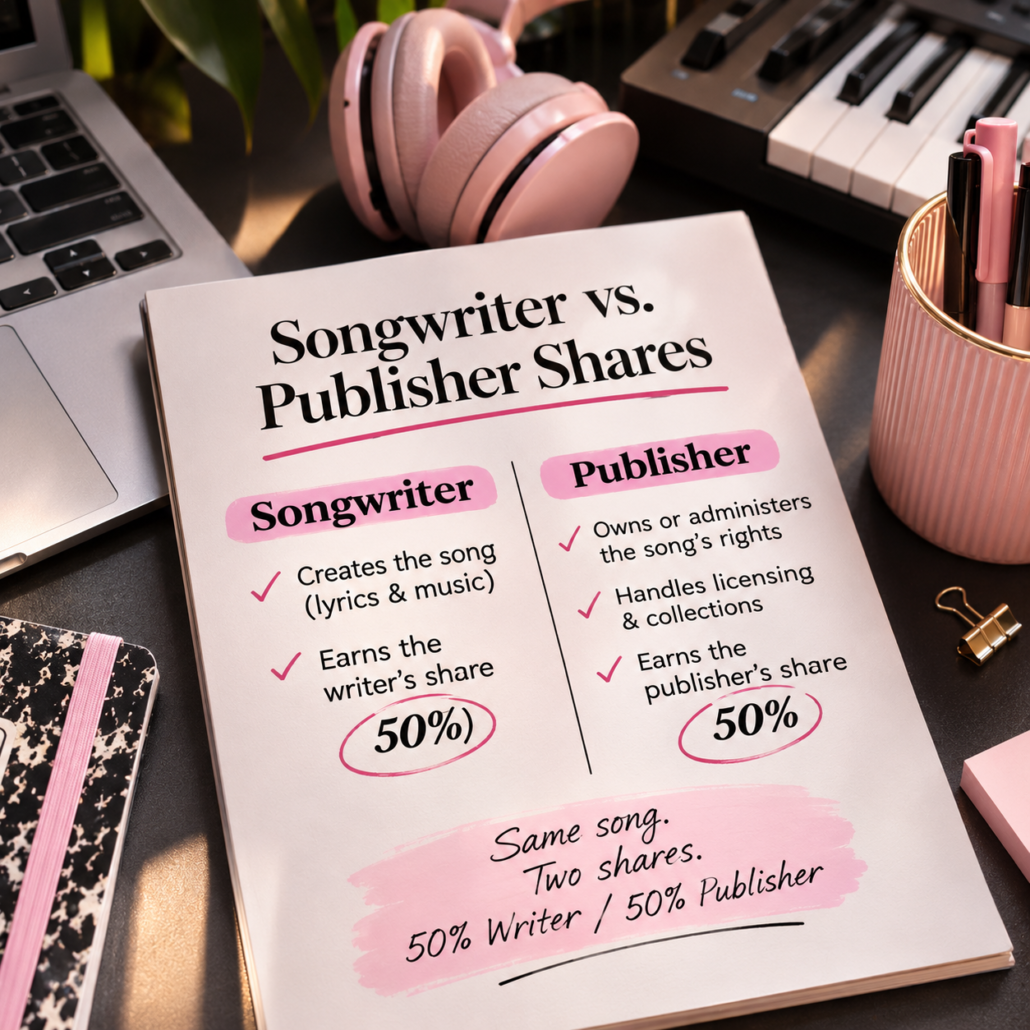
For public performance royalties, the conventional arrangement divides the royalty allocation into two portions:
- Writer’s share.
- Publisher’s share.
The writer’s share is associated with the songwriters.
The publisher’s share goes to the party entitled to that publishing interest, which may be an outside publisher or a self-published songwriter.
Here’s what many independent creators don’t realize:
You can be both the songwriter and the person controlling your publishing.
If you write your own songs and haven’t assigned your publishing rights to someone else, you may be self-published.
That means you may be entitled to collect both sides of the applicable performance royalties.
How Are Writer and Publisher Shares Divided?
Let’s use a simple example.
You write a song entirely by yourself and control all of the publishing.
For illustration, assume the song generates $1,000 in public performance royalties and the conventional 50/50 writer-publisher allocation applies.
| Royalty portion | Amount |
|---|---|
| Writer’s share | $500 |
| Publisher’s share | $500 |
| Total | $1,000 |
If you control both interests, you may be entitled to receive both portions through the appropriate registration and payment arrangements.
But if you have assigned the publisher’s share to a publishing company, that company may receive the applicable publisher portion under your agreement.
This is why you should understand exactly what you’re signing when you enter a publishing deal.
What Happens When Multiple People Write a Song?
Now let’s make things more realistic.
Imagine an independent artist and a producer create a song together.
The artist writes the lyrics and vocal melody. The producer creates original musical elements that form part of the composition.
They agree to split the songwriting 50/50.
That means each person has an agreed 50% interest in the composition.
If both retain and administer their respective publishing interests, their royalty allocation could look like this:
| Participant | Writer portion | Publisher portion |
|---|---|---|
| Artist | 50% of writer side | 50% of publisher side |
| Producer | 50% of writer side | 50% of publisher side |
In a hypothetical $1,000 performance royalty allocation under a conventional 50/50 writer-publisher arrangement, each collaborator could receive $500 across both sides.
But that assumes neither person has assigned their publishing interest elsewhere.
The actual payment depends on the PRO’s accounting system, the registrations, the parties’ agreements, and the applicable distribution rules.
What If One Songwriter Has a Publisher and the Other Doesn’t?
Here’s where things get interesting.
Let’s say an artist and producer agree to split a composition equally.
The artist has a publishing deal. The producer is self-published.
Their underlying songwriting split is still 50/50.
But their publishing interests are administered differently.
For a simplified illustration:
| Interest | Who receives or controls it |
|---|---|
| Artist’s writer share | Artist |
| Producer’s writer share | Producer |
| Artist’s publisher share | Artist’s publisher, subject to their agreement |
| Producer’s publisher share | Producer, as self-published rights holder |
The artist’s publisher doesn’t automatically receive the producer’s publishing interest just because it represents the artist.
And the producer doesn’t automatically receive the artist’s publishing interest.
Each person’s rights depend on the actual agreements.
This is why publishing splits and administration arrangements should be documented clearly.
Does a 50/50 Songwriting Split Mean You Split Every Royalty 50/50?
Not necessarily.
This is one of the biggest misunderstandings in music.
A 50/50 composition split doesn’t automatically mean two collaborators split all income generated by the recording.
Remember, a commercially released song typically involves two separate copyrights:
The composition: The underlying music and lyrics.
The sound recording: The particular recorded performance of that composition.
Composition ownership may affect publishing royalties, including performance and mechanical royalties.
Sound recording ownership may affect master royalties, licensing income, and other recording-related payments.
For example, a producer could own 50% of the composition but have no ownership in the master recording.
Or a recording artist could own the master but share the composition with several songwriters.
These are separate rights.
Don’t confuse songwriting percentages with master ownership percentages.
How Does This Work With ASCAP and BMI?
ASCAP and BMI collect public performance royalties for musical compositions.
Both account for writer and publisher interests, but they use different percentage scales.
ASCAP generally uses a 100% accounting basis, with the conventional writer and publisher portions represented as 50% each.
BMI uses a 200% accounting basis, with the conventional writer and publisher portions represented as 100% each.
That doesn’t mean BMI pays twice as much.
It means the accounting scales are different.
If you’re working with co-writers affiliated with different PROs, make sure the registration accurately identifies each writer, their affiliation, and their agreed interest.
For a deeper explanation, read our article Why Does ASCAP Use 100% and BMI Use 200%?
Do Mechanical Royalties Have Writer and Publisher Shares Too?
Mechanical royalties are publishing-side royalties, but they don’t necessarily follow the same payment structure as PRO performance royalties.
For example, The Mechanical Licensing Collective (The MLC) collects eligible U.S. digital audio mechanical royalties from participating streaming and download services.
Unlike ASCAP and BMI, The MLC does not distribute separate writer and publisher shares.
Instead, it pays the party authorized to collect the mechanical royalties for the applicable publishing interest.
That could be a publisher, publishing administrator, or self-administered songwriter.
If a publishing administrator collects royalties for you, your agreement determines how those royalties are passed along and whether an administration fee is deducted.
This is another reason to understand your publishing agreements instead of assuming every organization handles royalties the same way.
What Is a Publishing Administration Deal?
A publishing administration deal generally involves a company managing certain publishing responsibilities on your behalf.
Depending on the agreement, that may include:
- Registering compositions.
- Collecting royalties.
- Monitoring usage.
- Handling royalty statements.
- Managing certain licensing and administrative tasks.
An administration agreement does not necessarily mean you’ve sold your copyrights.
However, the company may receive an administration fee, and the agreement may give it exclusive control over certain rights or collections for a specified period.
Read the terms carefully.
A traditional publishing deal may involve broader rights, including an assignment or co-ownership of copyright interests, creative services, and other obligations.
Administration and ownership are not the same thing.
What Should Be on a Songwriter Split Sheet?
A split sheet helps document who contributed to a song and how the collaborators agreed to divide the composition.
At a minimum, it should identify:
- Official song title.
- Songwriters’ legal names.
- Professional names, if applicable.
- Contact information.
- PRO affiliations.
- IPI numbers, when available.
- Agreed composition ownership percentages.
- Publishing information, if applicable.
- Signatures or other clear written approval from the collaborators.
A split sheet isn’t a substitute for every possible legal agreement, but it provides an important written record of the collaborators’ understanding.
Don’t wait until the song becomes successful to discuss ownership.
Handle the splits while everybody is still in the room.
Five Questions Every Songwriter Should Ask
Before releasing your next record, make sure you can answer these questions:
1. Who actually wrote the composition?
Identify everyone who contributed to the underlying music and lyrics.
2. What percentage does each writer own?
Get the agreed composition percentages in writing.
3. Who controls each person’s publishing?
Find out whether each writer is self-published or represented by a publisher or administrator.
4. Who is responsible for registering the song?
Make sure the work is registered accurately with the appropriate organizations.
5. Who owns the master recording?
Document that separately. Composition ownership and master ownership are not interchangeable.
FROM THE SOUTHERN GIRL & CO. DESK
You can make an incredible song with people you love working with and still end up in a business disagreement if nobody talks about ownership.
And here’s the thing: discussing splits doesn’t have to ruin the creative process.
It’s part of respecting the people who helped create the music.
Know who wrote what. Agree on the percentages. Understand who controls the publishing. Keep the paperwork together.
Because if you’re serious about building a catalog, you need to know more than how many songs you’ve released.
You need to know what you own, what you’ve agreed to share, and who’s responsible for collecting the money.
That’s how you start treating your music like the business it is.